Understanding Phone Use
For our User Experience Research Methods class, taught by Dr. Stephanie Valencia, our team studied how UMD students who describe themselves as having “phone addiction” experience, manage, and make sense of their phone use. Through contextual interviews and a four-day diary study, we explored the emotional, social, and environmental factors that shape phone habits.
Researcher
Oct-Nov 2025
Abhinav Das
Evelyn Lee
Saaniya Phatak
Ximeng Deng
Stuti
Qualitative Research, Research Synthesis,
Cross-disciplinary Collaboration
Exploring the emotional, contextual, and social patterns behind phone use
With mobile phones becoming an inseparable part of daily life, phone addiction is increasingly affecting students’ mental well-being, social relationships, and productivity. Phones help students stay connected, pass time, manage tasks, and take breaks, but they can also become a source of distraction, guilt, stress, and lost productivity.
For this project, we studied how UMD students who self-identify with phone addiction perceive, justify, and cope with their phone habits. We focused on the emotions, routines, environments, and social situations that shape when, why, and how students use their phones.
We wanted to understand phone use beyond screen time by looking at the emotions, contexts, and coping strategies that shape students’ habits
01
How do students use their phones, and how does this influence their mental well-being, productivity, and social interactions?
02
How do contextual factors, such as environment, time of day, emotional state, or social context, shape when and why students reach for their phones?
03
How do students currently manage their phone habits and what support do they imagine for building healthier digital routines?
Exploring the emotional, contextual, and social patterns behind phone use
To collect our data, we conducted in-person Contextual Interviews with 6 participants, and a four-day Diary Study with 20 participants.
Recruiting our participants
We recruited UMD students (18+) through convenience sampling via Reddit, Slack, Discord, and personal networks
2 Undergrad students
2 Master's students
1 PHD student
19 Master's students
1 PHD student
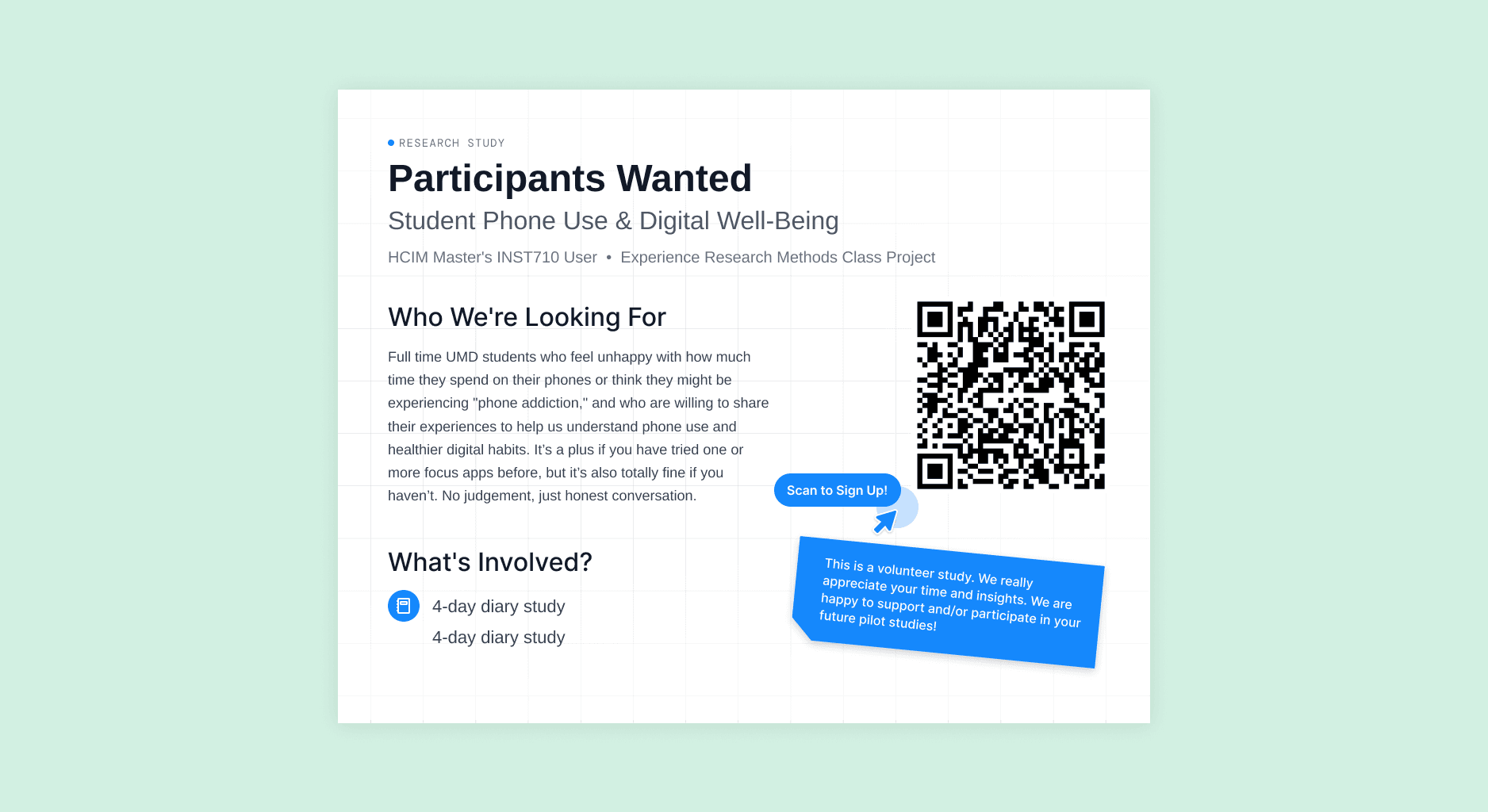
We posted this flyer across online communities to reach participants
Conducting the interviews
Each session followed a semi-structured guide across 7 topic areas, ending with a think-aloud walkthrough of the participant's own phone.
Structuring the diary study
Over 4 days, participants received two diary to fill each day via Google Forms.

Interviews to interpretation sessions
Our interviews helped us gather contextual data on participants' phone use and its effects on their mental wellbeing, productivity, and social relationships. After each session, the interviewer and note-taker debriefed with the rest of the team, who asked questions to clarify observations, generate insights, and align on key takeaways.
To prepare for analysis, each participant was assigned an ID from P1 to P6, in the same order as their interview sessions. Interpretation notes were then written for each participant — each note capturing a single, self-contained idea such as a quote, activity, belief, insight, or opportunity. These notes would later feed directly into affinity diagramming.

Interpretation sessions to affinity notes
The data collected was then translated into affinity notes, with each note being tagged with the identification number of the corresponding participant

Diary study to affinity notes
Each diary entry was analysed to extract insights on participants' phone use habits — how usage shifted based on location, social situation, and emotional state, and what kept participants on their phones for extended periods. These insights were translated into affinity notes, using the same tagging system as the interview notes, and combined with interview data to surface correlations and common themes.

Building the Affinity Diagram
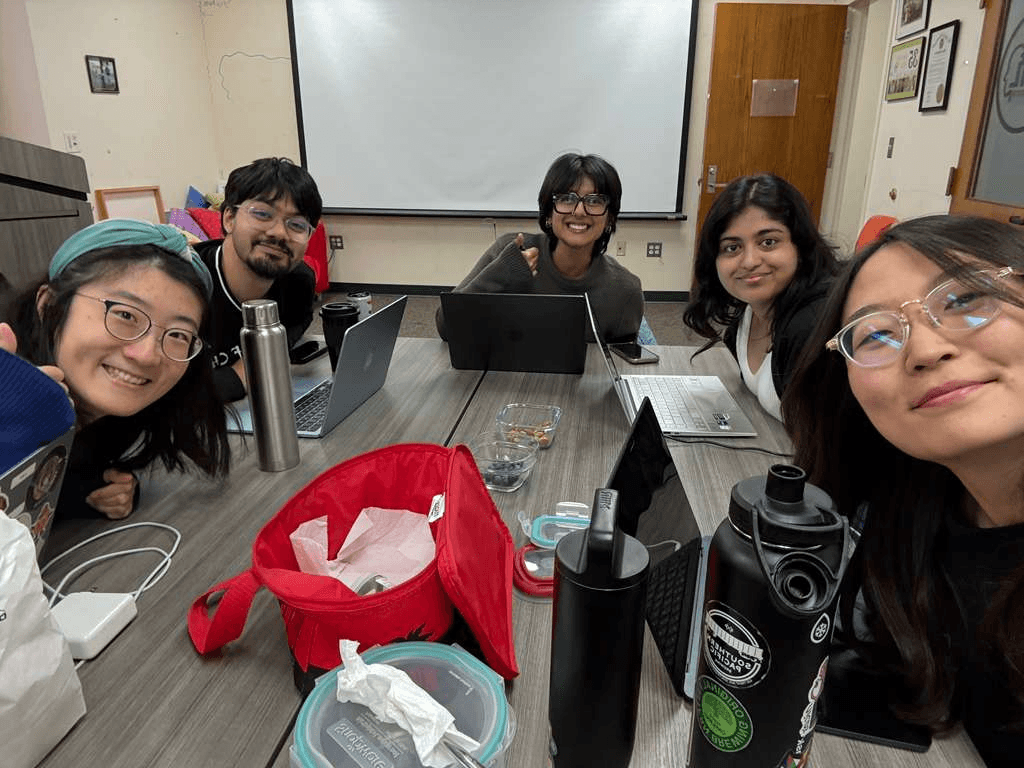
After generating affinity notes from both our interviews and diary studies, we brought them together and built an affinity diagram to surface patterns across participants.
We used an inductive approach — starting from the data rather than working from predetermined themes, and building bottom-up across three levels:
Yellow notes were the affinity notes, each containing a single, self-contained idea such as a quote, activity, belief, insight, or opportunity drawn from the interviews or diary studies.
Blue notes captured higher-level insights derived directly from the data, written in the first person to stay close to the participant's voice — each one a label summarising a cluster of yellow notes beneath it.
Pink notes sat above the blues, representing a specific idea, concept, or issue that several blue notes pointed toward — also written in the first person, with up to 8 blue notes feeding into each.
Green notes sat at the top, representing a broad area of concern that connected related pink notes — written in the third person as an overarching theme.

As a team, we talked through each cluster and adjusted notes as needed — moving notes, merging groups, and renaming clusters multiple times until the labels clearly reflected a shared understanding of the data. This iterative process ensured that everyone had the same understanding and that every theme we carried forward had been interrogated and agreed on as a team. These themes later guided our experience models and identity models.

Emerging themes - Affinity Diagram
The affinity diagram surfaced the following recurring themes.


Understanding Our Users Through Identity Models
Using patterns from the affinity diagram, we grouped similar behaviours, emotions, and motivations into distinct identity types — each representing a different relationship people have with their phones.
Rather than designing for a generic user, the identity model grounds our decisions in real needs, frustrations, and motivations — showing us where people struggle, what they value, and where interventions could be most meaningful.

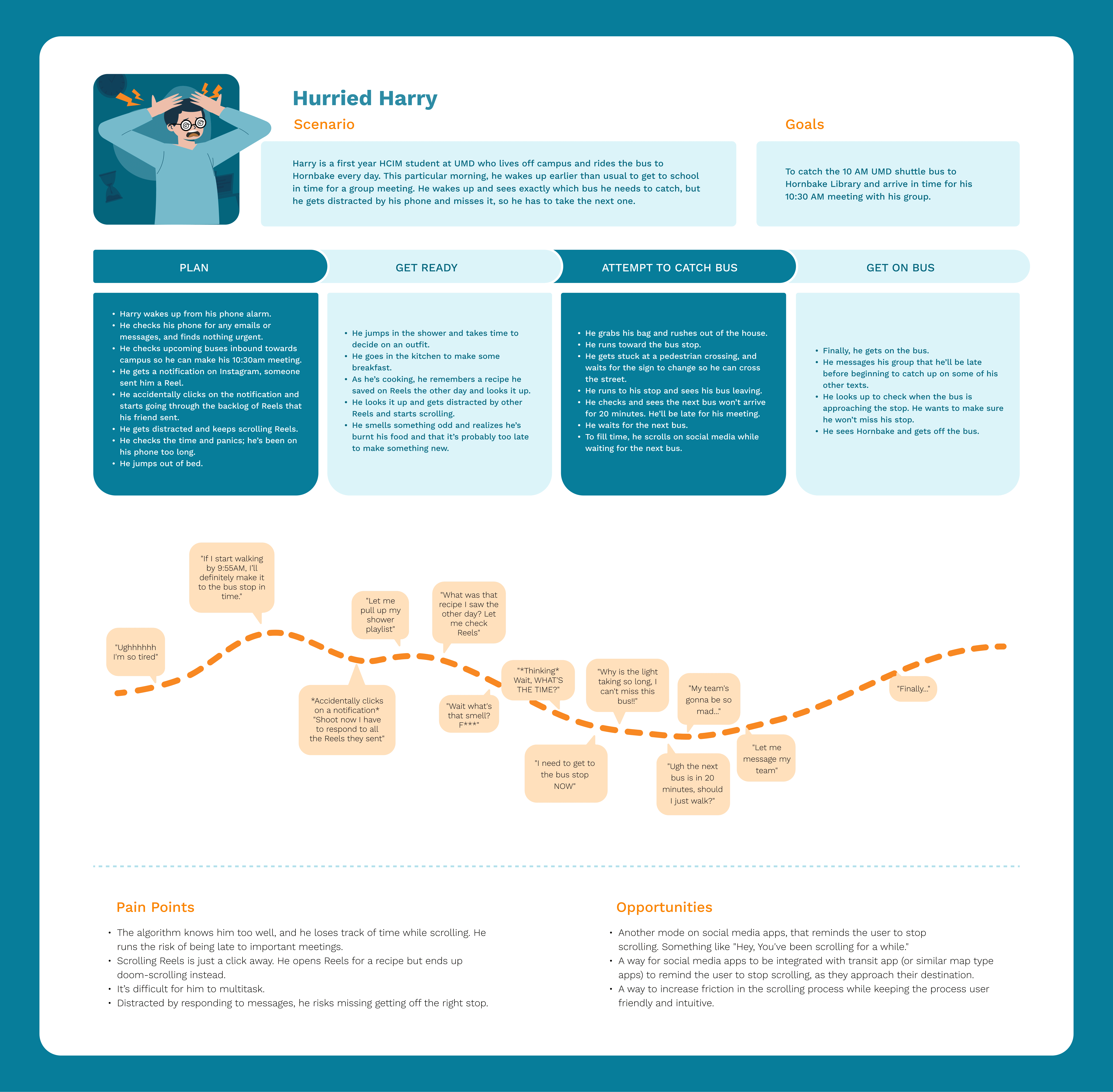
User Journey Map
Tracing how phone use shapes focus, emotions, and decisions in different moments across contexts, identifying opportunities for intervention.
Visioning Process
As a team, we started the visioning process by sitting together and talking through ideas based on our research. Everyone added onto each other’s thoughts, and ideas kept evolving through discussion rather than being fully formed from the start. This helped us explore different directions without locking into a single solution too early.


We grouped our ideas into five distinct visions, each addressing a different aspect of our research insights. For each vision, we listed pros and cons and generated specific design ideas to make them concrete. To prioritise, we used a red, yellow, and green system — green for must-haves, yellow for nice-to-haves, and red for things to avoid.

In the end, we chose the vision that felt the strongest and most aligned with our research, and the one we were most convinced by as a team. We also incorporated few design ideas from the other visions that fit naturally with the final direction.
Final Conceptual Vision
Replace passice consumption with real connection
An app that redirects students from passively consuming content about other people's lives to staying connected with friends and maintaining a sense of community. Rather than scrolling through algorithmic feeds, students add friends and casually share things they find interesting, which can naturally lead to in-person activities or clubs.
Students can also organise their day by syncing their schedule and assigning focus modes to each activity. When it is time for a task, the app gives contextual reminders asking if they want to enter focus mode, and allows friends to join the same session — making productivity a shared activity when they want it to be.
When a user exceeds the social media limit they set, or scrolls during a scheduled task, the app nudges them toward content shared by friends instead. These prompts redirect the instinct to scroll toward discovering things shared by people they actually know, helping build community both online and offline, without relying on distracting algorithms.
The redesigned flow made cab modifications faster, clearer, and less repetitive
📐
🗒️
Affinity mapping turned out to be a deeply iterative process. Clusters got renamed, split, and merged more times than we expected, and our strongest themes only emerged after we pulled apart groupings we thought were settled.
I had the best time working on this with my team members. Also, a huge thank you to Dr. Stephanie Valencia, we learned so much from this class!